


Place des Palmistes
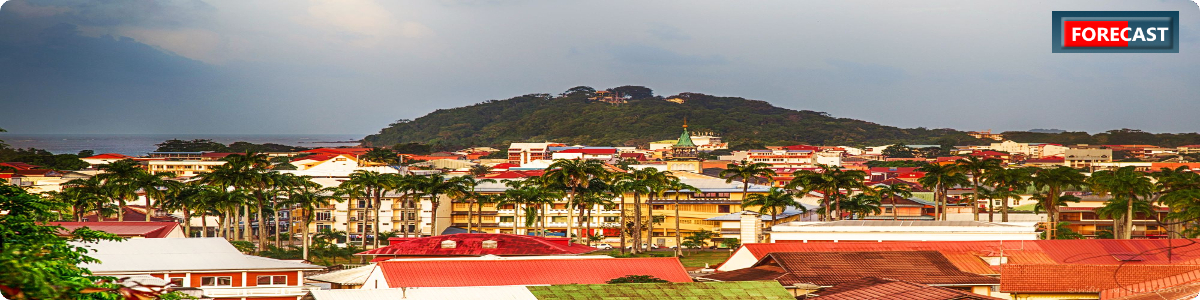
Somewhere for locals and tourists to meet up and relax, Place des Palmistes is a linchpin of social life in Cayenne.
It’s a large square gridded with palms and edged by Creole houses with wooden balconies over shops, bars and eateries.
At the centre of the lawn is a statue of Félix Éboué, a Guianan administrator who in 1936 became the first black man to hold a senior colonial position when he became Governor of Guadeloupe in 1936. He was also the first black man to have his ashes placed at the Pantheon in Paris after he died in 1944. The square also where a lot of the festivities go down during the epic 10-week carnival at the start of the year.
Cayenne Market
A couple of blocks down from Places des Palmistes on Rue de Lieutenant Becker is the city’s market, which trades on Wednesdays, Fridays and Saturdays.
Come for a taste of Guianan culture, sampling the various rum punches and browsing stalls selling anything from Vietnamese pho noodles to local handicrafts.
The fruit and vegetables come from all over French Guiana, but also Surinam, Laos, Brazil and even Haiti.
You can shop for things you know, like bananas, pineapples or mangoes, or more exotic produce like awara or rambutan.
If it’s all a bit bewildering the traders are approachable and always happy to offer advice.
Guiana Carnival
The big annual event in French Guiana kicks off on Epiphany just after Christmas and doesn’t end until Ash Wednesday in February or March.
The carnival has Creole origins, and started during the days of slavery as a way for people to celebrate fertility and harvest and poke fun at Europeans in secret at a time when public celebrations were banned.
On Friday and Saturday nights throughout this period there are masked balls, but the whole thing builds to the four days before Ash Wednesday when there are all kinds of parades and organised craziness like burlesque weddings where men and women swap genders.
Guyane's Zoo
It’s not often you can say that you’ve been to a zoo in a real jungle.
And the Zoo de Guyane is just that, with paths through luxuriant tropical foliage and bridges suspended in the canopy to get you closer to the monkeys.
There are 450 animals from 75 species, all native to Guiana, and in a much more convenient setting than if you were hacking through genuine wilderness.
There are macaws, pumas, jaguars, ocelots caimans, giant anteaters and iguanas, all in spacious and humane enclosures.
It will take at least two hours to investigate every trail, which are well-signposted and adapted for wheelchairs and strollers.
Rémire-Montjoly Beach
A strange thing about the coastline around Cayenne is the absence of those classic tropical beaches: The powerful Cayenne and Mahury rivers pull silt out of Guiana’s inland and deposit it all along the coast, leaving the shoreline muddy and the water a little murky.
Most people do their bathing at hotel or municipal pools, but the palm-lined Plage Rémire-Montjoly is a good pick if you want the ocean, and lies a maximum of 15 minutes from the centre of Cayenne.
At night in May, June or July you may witness the memorable spectacle of sea turtles scrambling ashore to lay their eggs.
Guiana Space Centre (CSG)
You’ll need an hour to reach the space centre, which is just the other side of Kourou.
But as this is a rare chance to see an operating spaceport you’ll have no second thoughts . Even if you only have a passing interesting in space exploration and astronomy you’ll be amazed by the kind of access you’re given at the CSG: You can visit the banks of consoles in mission control, get close to launch pads that conduct around ten missions a year.
The guided tour is in French but does cater for English and Dutch speakers, and doesn’t skimp on the technical details if you’re a real enthusiast.